
Annual Report 2024-25
Contents:
Summary of the year
Welcome to our Annual Report for 2024-25
2024-25 has been a busy and productive year for the London Kidney Network (LKN) and our partners.
This report sets out our plans for 2024-25 and highlights the key achievements within each of our workstreams. We have much to be proud of.
We established the first formal London Kidney Transformation Board. This means we now have formal recognition and accountability to senior decision-making bodies in the NHS in the capital. Through the board, we are making the case for greater investment in kidney care in London.
Our focus on helping London balance demand and capacity for in-centre haemodialysis has produced positive outcomes. This work was based on the Kidney Dialysis Occupancy Measure (DOM) and 10 Year Plans for growth, developed by the LKN and partners in London.
Three London Integrated Care Boards (ICBs) have agreed to invest in dialysis capacity in 2025-26 as a direct result of our advocacy and presentation of a compelling case explaining the risk to patient experience and the quality and safety of dialysis care in London.
As the prevalence of chronic kidney disease (CKD) grows, we continued to support London ICBs and renal units working on their Renal Transformation 3Ps pilots (3Ps). The 35 projects/pilots across 5 ICBs cover preventing CKD progression and all modalities for treatment of end stage kidney disease. They are starting to show evidence of impact and value.
NHS London agreed to continue with a third year of funding in 2025-26, i.e. a total of £15m invested in the kidney pathway to help reduce the rate of growth in demand.
Beyond our London partners we have collaborated with national and regional organisations on a range of projects this year which confirms the growth and influence of the LKN:
-
- Through our work with all 8 NHS kidney networks in England, the Kidney DOM is now being used by all 48 kidney units and 270 dialysis locations
- We led development of a tool to understand the Root Cause Analysis (RCA) of infections in peritoneal dialysis patients through the national Dialysis Community of Practice
- Our joint work with Kidney Research UK, the leading research charity into kidney disease in the UK, and partners in South East London created the HIDDEN CKD Community Toolkit to help Integrated Care Systems (ICSs) engage and test for kidney disease in underserved populations
- Collaborations with Kidney Care UK, a nationwide patient advocacy charity, have resulted in a Peer Support service and a programme of live educational webinars for people living with CKD stages 1-3 in London
We are hosting more face-to-face events (with greater numbers of attendees each year), based on feedback that people value coming together with colleagues to learn and share experience. Through our leadership fora and educational programmes, we have supported over 50 speakers and 900 attendees in diverse subjects, from vascular access and transplantation to health inequalities and psychosocial wellbeing.
LKN colleagues were proud to share their work at UK Kidney Week 2024 in Edinburgh. Our teams led 7 oral sessions and presented 8 abstract posters, with two posters awarded best poster in their session.
Patients’ insights have shaped every part of our work. The Patient Experience Groups, each with a key theme from our clinical workstreams, have been attended by more than 50 patients and carers. In-depth conversations with multi-professionals have covered subjects ranging from the reasons dialysing at home is a challenge, to the ethics of supportive care. We are incredibly grateful for the time and energy patients commit to help guide our work.
The year ended by reviewing our priorities for 2025-26 and refreshing our structure and our team. We owe a debt of gratitude to our longstanding team members that have left the LKN and are pleased to welcome new faces to diversify our skills and experience to meet the changing needs of our work.
We head into 2025-26 with confidence that our strategic priorities align with the needs of the kidney community in London. Our focus will continue to be balancing demand and capacity, improve the scope and effectiveness of preventing or delaying progression of CKD, and maintain attention on reducing health inequalities.
We will continue to build strong and productive relationships with our partners in London and across England and are always keen to make connections that lead to a better kidney service for Londoners.
This summary Annual Report does not capture the amount of human endeavour that has gone into the many collaborations, conversations and the hours of goodwill given willingly by many people to help make a positive impact together.
Thank you to our patients, partners and collaborators.

Stephen Cass
LKN Director

Dr Rob Elias
LKN Clinical Director
A word from our Chair

Dr Josephine Sauvage
Co-Chair of the London Kidney Transformation Board
As Chief Medical Officer for North Central London ICB and Co-Chair of the London Kidney Transformation Board, this work holds particular significance for me. We are facing emergent pressures on dialysis capacity across London, and the Board’s strategic leadership has been vital in helping systems respond with urgency and foresight. The collaborative efforts to model demand, advocate for investment, and support local planning are already making a tangible difference to patient care and safety.
Yet, our ambition must go further. We must continue to shift our focus upstream—towards, early detection, preventing or delaying progression, and optimal management of CKD as part of long-term conditions. This is especially critical in addressing the stark inequalities in outcomes that persist across our communities, driven by wider determinants of health. The London Kidney Transformation Board has laid strong foundations, and I am deeply impressed by the progress made. I look forward to another year of scaling impact, strengthening partnerships, and driving better outcomes for all Londoners.
The London Kidney Network Team
Thank yous and goodbyes
We say an enormous thank you to the clinical leads who have worked with us over the last three years and left our team during the year. They have been fundamental to our progress and to leading changes to improve the lives and treatments of kidney patients in London, now and in the future. We are pleased that many are staying in the workstream groups to remain a key part of the LKN work.
Thank you to: Kieran McCafferty, Lisa Silas, Sapna Shah, Ismail Mohammed, Joyce Popoola, Deepa Kariyawasam, Gavin Dreyer, Ben Lindsey, Ravi Rajakariar and Wendy Brown.
The Chair of our LKN Board, James Marsh, also stepped down during the year. James has done a great job over many years, guiding the development of the Board and helped build the foundations for the new London Kidney Transformation Board.
They will be missed, and we are grateful for all their hard work during their time with us.
And welcomes
During the year we welcomed new faces to the LKN team: Donna Morgan from St George’s as our Lead Nurse, (Workforce and Quality) and new Clinical Leads Suzanne Forbes from Barts (Dialysis), David Evans from Epsom & St Helier (Supportive Care) and Marie Condon from Imperial (Transplant and Demand & Capacity).
Radhika Lakshman also joined the Programme Team as Project Coordinator, and Deniz Hasan as Peer Support Co-ordinator (a joint post with Kidney Care UK).
Following the departure of James Marsh, the new London Kidney Transformation Board is co-chaired by Dr Jo Sauvage, Chief Medical Officer from North Central London ICB, and Kate Slemeck, Managing Director from St George’s Hospital.
We look forward to working with them, and you, to keep delivering improvements to kidney care in London.
Summary Workplans & Achievements for 2024-25
CKD Prevention Workplan
Our plan for 2024-25
- Develop and support implementation of a CKD pathway and information for early identification and preventing progression .
- Develop and support implementation of a CKD pathway and information to optimise CKD management and SGLT2 inhibitors in CKD patients.
- Determine collaborative opportunities with partners/networks on joint Prevention work.
What we achieved
- Created and shared CKD Resources Packages for patients and primary care, and CKD solutions.
- Convened national CKD Community of Practice.
- Supported ICSs with developing and delivering their CKD prevention plans.
- Worked with ICSs on their 3Ps pilots CKD metrics, leading to close alignment with LKN priority CKD metrics.
- Shared learning and expertise, and raised awareness, e.g. via oral and poster presentations, and published articles and interviews.
- Co-created with Cardiorenal Metabolic (CRM) Network Groups, and shared/implemented CRM messaging document.
- Co-created with HIDDEN CKD team and Kidney Research UK HIDDEN CKD Community Toolkit, i.e. a way for ICSs to engage and test for CKD in underserved populations.
- Worked with Kidney Care UK on their new primary care resources web pages.
- Provided with Kidney Care UK online and live educational webinars for people living with CKD stages 1-3.
- Advised on key CKD metrics for national Clinical Reference Group benefits realisation tool.
- Completed submission to influence national proposal for 2026/27 Quality Outcomes Framework (QOF) to include uACR testing.
Advanced Kidney Care Workplan
Our plan for 2024-25
- Ensure all patients with progressive CKD, who are expected to progress to end-stage kidney disease (ESKD), have access to a comprehensive advanced kidney care clinic (AKCC).
- Ensure London AKCCs include all key specialties including transplantation, home therapies and supportive care, with psychosocial care and symptom management also easily accessible.
- Ensure patients are supported to make the best choice for management of ESKD through shared decision making.
What we achieved
- Established steering group, with good engagement and multi-professional representation across London, includes the patients’ voice.
- All London units completed baseline questionnaire to understand services and barriers to providing optimal care.
- Compared London Advanced Kidney Care (AKC) services to help understand deficits and pan-London priorities.
- Gathered and reviewed patients’ insights to help inform supporting pre-AKC patient education.
- Identified key areas for focus in 2025-26.
- London involvement in national Transform AKC Project.
Transplant Workplan
Our plan for 2024-25
- Develop and implement the five-year London transplant plan in line with NHS Blood & Transplant (NHS BT) Organ Utilisation Guidance (OUG), Getting It Right First Time (GIRFT) and Renal Service Transformation Programme (RSTP) guidance across all centres
- Implement ‘Transplant First’ protocols London-wide, optimising donor-offer acceptance and utilisation rates
- Map the RSTP-defined transplant multi-disciplinary team (MDT), deliver targeted training and submit business cases for workforce expansion
- Launch equity-focused outreach and patient-navigator programmes to ensure all eligible patients are offered and receive transplants
- Formalise collaborations with charity partners, peer-support and education leads, and co-host joint patient education initiatives
What we achieved
- Cyber-Resilience Platform – Rolled out a dedicated response platform post-cyberattack and adapted mutual-aid protocol with new activation criteria.
- NHSE Tariff Reform Advocacy – Secured ongoing LKN seats at NHSE tariff forums, delivering clinical validation and data insights for equitable transplant funding.
- Referral Pathway Mapping – Produced end-to-end patient‐referral maps for all centres, embedding 18-month review cycles to streamline care and close system gaps.
- Mutual-Aid Guidance Publication – Published the updated protocol with embedded performance metrics on both LKN and NHSBT sites, and launched the Mutual Aid patient information leaflet.
- Community Engagement Sub-Group – Established with National Black, Asian & Minority Ethnic Transplant Alliance (NBTA) and partners, drafted terms of reference and workplan to extend faith and ethnicity tailored organ donation outreach.
- Transplant-Growth Modelling – Partnered with LKN business intelligence (BI) to build scenario analyses (–1 %, 0 %, 1 %, 2 %) for long-term capacity planning and strategic decision-making.
Vascular Acess Workplan
Our plan for 2024-25
- Review and amend day-case criteria for vascular access (VA) procedures to optimise same-day discharges
- Develop a standardised role description for clinical nurse specialist (CNS) and VA coordinator posts, and pilot across London units
- Expand VA nursing training into a pan-London package replacing Managing Access by Generating Improvements in Cannulation (MAGIC), incorporating 2023–24 event feedback
- Revise 2023–24 nursing quality-marker metrics and publish regular, unit-level performance reports
- Define key performance indicator (KPI) set to support local business-case development and drive service enhancements
- Continue partnering with units on bespoke e-pathway roll out to resolve data reporting challenges
What we achieved
- VA Quality Metrics and KPIs Established – Translated agreed VA data items and quality markers into a focused set of trust level metrics and KPIs, pending final clinical sign off.
- Developed Patient Information Addressing Common Misconceptions – Drafted patient leaflets on VA and permanent lines risks/benefits, ready for clinical refinement and multi-format rollout.
- Cross-Centre Training and Collaboration – A new collaboration enabled percutaneous access training for a Royal London Hospital (Barts) clinician at Epsom & St Helier. The team at Barts also collaborated with the Royal Free Hospital vascular access team to explore introducing an electronic referral pathway.
- Nursing Subgroup Strategic Focus Defined – Set nursing workstream priorities, needling standards, leadership development, education, patient information quality, and data collection.
- Arteriovenous Fistula (AVF) Resource Calculator Model Developed – Developed and validated the AVF resource calculator model, providing a data driven tool to forecast surgical workload needed to maintain and improve VA rates. It supports strategic planning by quantifying annual and weekly procedure requirements, enabling optimised allocation of theatre sessions and workforce resources.
Dialysis at Home Workplan
Our plan for 2024-25
- Develop a framework to model future demand and capacity (D&C) for Dialysis at Home to secure adequate resources for infrastructure, training, and patient support to sustain Dialysis at Home growth, high-quality care, and accessible services.
- Optimise peritoneal dialysis (PD) access and care pathways by promoting percutaneous catheter insertion and re-insertion processes.
- Reduce peritonitis rates and improve patient outcomes through London-wide collaboration by embedding Root Cause Analysis (RCA) to keep patients longer on PD.
- Strengthen patient support and decision making across the dialysis journey by embedding peer support into modality choice, treatment initiation, and ongoing care.
- Drive continuous quality improvement (QI) in Dialysis at Home through real-time UK Renal Registry (UKRR) daily feed integration and proactive data use to identify and address improvement opportunities.
What we achieved
- Root Cause Analysis rollout – The RCA tool, adapted in partnership with the Midlands Kidney Network, was implemented across all seven units. This forms the basis for future evaluation of catheter loss, patient experience, and broader quality outcomes.
- PD percutaneous access training – A new training partnership between Royal London Hospital (Barts) and Epsom & St Helier enabled the first consultant to complete PD percutaneous access training through the dialysis at home curriculum. This marks a step towards standardised PD access capabilities across London.
- Collaboration – The Pan-Thames in-person meeting was highly attended (particularly by nurses) and focused on sharing successful practices in PD and home haemodialysis (HHD), including RCA use and peer support integration.
Supportive Care Workplan
Our plan for 2024-25
- Increase the number of people appropriately accessing the supportive care pathway through shared decision making in Advanced Kidney Care Clinic.
- Increase the number of people with a documented Advanced Care Plan.
- Ensure a skilled workforce is confident to deliver supportive care and advanced care planning in London, including symptom management and psycho-social support.
What we achieved
- Worked as a Community of Practice to support implementation of the 3Ps Frailty & supportive care projects.
- Expert/key advisor on 3Ps supportive care and frailty metrics (and KPIs) to help inform external evaluation (and future care) by the Midlands & Lancashire Commissioning Support Unit.
- Developed/agreed comprehensive plan for pan-London supportive care audit.
- All units completed RSTP supportive care Self-Assessment Questionnaire, results compared/used to identify pan-London and local priorities for improvement.
- Produced comprehensive patient information.
- Ongoing use of supportive care training module.
- Co-created Dialysis Withdrawal Guidelines.
Young Adults Workplan
Our plan for 2024-25
- Ensure equitable access to dedicated Young Adults (YA) kidney clinics across London, supported by a standardised Young Adult standard operating procedure informed by national and local best practice.
- Embed psychological support as a core component of YA kidney pathways to improve mental wellbeing, resilience, and treatment participation.
- Implement a pan-London best-practice approach to medication adherence for YA to optimise treatment effectiveness and long-term health outcomes.
- Embed routine measurement and reporting of agreed YA metrics via the LKN system dashboard to drive quality improvement and accountability.
- Strengthen workforce capability by developing targeted MDT training that equips all professionals to meet the unique clinical and psychosocial needs of YA patients.
What we achieved
- Psychosocial provision – report published outlining existing variation in provision and helping to support local improvement efforts.
- Youth Worker subgroup – established as a collaborative platform to share practice, develop consistent models of support, and address variation.
- User Experience survey – piloted at Guy’s and developed into a fuller audit to build a comprehensive view of YA needs across London.
- YA Data metrics – data definitions and criteria defined to support more accurate service planning and equity monitoring for London.
- YA Passport – a patient-held YA passport was co-designed with two young adult patients. Supports the transfer of essential medical and psychosocial information across care settings.
Health Equity Workplan
Our plan for 2024-25
- Embed equity at the core of all LKN workstream activities to ensure no action exacerbates existing health inequalities for people with kidney disease.
- Reduce health inequalities by equipping and supporting the kidney care workforce with the knowledge, skills, and resources to deliver equitable care.
- Achieve widespread adoption and continuous improvement of the renal Health Inequalities e-module to strengthen workforce capability and drive sustained change in practice.
What we achieved
- Making Every Contact Count Pilot – following a successful pilot at Barts Health, this was presented at the LKN Leadership Forum. Alongside productive discussions around prevention and social prescribing, this led to numerous plans to adapt within local pathways.
- UKKW Presentation – highlighting work on tackling kidney inequalities and the development of the Health Equity e-module.
- Data Metrics Reporting – now a standard feature of the LKN data pack, reinforcing the role of the group in informing strategy and driving systemic change across the kidney pathway.
Measuring Progress: Data and metrics
The LKN values data and strives to be evidence led in defining the case for change and measuring the improvements in outcomes via our quarterly data pack and system dashboard. The core aims are to utilise data to highlight unwarranted variation, as well as evidencing dialysis growth data to help strategic planning.
Peter Wilson, LKN Business Intelligence Manager and the Clinical Information Group members continue to refine and develop these to distil the complex Kidney Pathway for our units and patients across London.
You can find our data packs here https://londonkidneynetwork.nhs.uk/data/
If you would like to see the dashboard, please email us at lkn.londonkidneynetwork@nhs.net
Data in action: A case study
The Kidney Dialysis Occupancy Measure (DOM) for London and England
LKN modelling of demand and capacity of In-Centre Haemodialysis (ICHD), showed demand growth of around 3% per year, with local variation across the seven renal units in 48 locations in London.
With clinical consensus and agreement from the London renal unit Clinical Directors and Clinical Leads, the LKN developed a standard and consistent measure of ICHD capacity, i.e. the Kidney DOM. It is intended to be simple to use, easy to measure, and easy to report proxy indicators of clinical safety, patient experience and service resilience.
Despite best efforts to mitigate this growth, including early identification and preventing/delaying CKD progression, higher rates of transplantation, and expanding home therapies, demand growth will continue. Working with units, we found that use of ICHD estate capacity was at 88.2% (range 65.2 % – 102.7%) and available staffed capacity at 98.8% (range 87.0 % – 108.0%) across the whole of London by end 2024-25.
We consolidated our Kidney DOM work in 2024–2025 within London and began working with our teams to scope key quality metrics to sit alongside the headline Kidney DOM. We also collaborated with our fellow renal networks in the other regions to establish a national Kidney DOM summary.
Bar Chart Key:
LDN = London
RFH = Royal Free Hospital
IMP = Imperial
GSTT = Guy’s & St Thomas’
KCH = King’s College Hospital
SGH = St George’s
ESTH = Epsom & St Helier
April 2025


April 2025


Education and Events

4 in-person events

8 Leadership Fora

3 National Webinars

1060 Participants

69 Presenters

32 hours of teaching
Brilliant presenters and engaging participants in 2024-25 were from across London and England. They included: nurses, GPs, patients, nephrologists, pharmacists, dietitians, physiotherapists, occupational therapists, psychologists, service/project/programme managers, commissioners, data managers, NHS England, ICS leads, and representatives from charities, Health Innovation Network and industry.
UK Kidney Week 2024
The table below shows the depth and breadth of the LKN work that was selected for showcasing at UK Kidney Week 2024, which can be accessed here: https://londonkidneynetwork.nhs.uk/training/
| Category | UK Kidney Week 2024: LKN Abstracts & Oral Presentations | Lead |
|---|---|---|
| CKD Prevention | Kidney networks: adding value by working together – showcasing CKD prevention | Stephen Cass, Oral presentation |
| Working together to improve CKD outcomes across England & Wales | Linda Tarm, Oral presentation | |
| The devil is in the data - lessons learnt in CKD | Kieran McCafferty, Oral presentation | |
| CKD Coding Guidelines and data sources for CKD metrics: a LKN report | Linda Tarm, Poster abstract | |
| New clinical pathways to transform identification and management of early stage CKD in people with and without Type 2 diabetes across London | Linda Tarm, Oral abstract presentation | |
| Transplant | London Transplant Collaborative Patient Co-Designed Pathway for Mutual Aid | Lisa Silas, Poster abstract |
| Home Therapies | Modelling Peritoneal Dialysis starts to support Home Dialysis growth | Richard Corbett, Poster abstract |
| What is needed to Improve PD access pathways across a regional network? | Bhrigu Sood, Poster abstract | |
| Peritoneal dialysis nursing workforce: how does variation within a regional network effect quality of care? | Katie Durman, Oral abstract | |
| Supportive Care | LKN supportive care data audit: Exploring the possibilities; understanding the challenges | Katie Vinen, Poster abstract |
| Collaborative working through a renal network to lead improvements in Supportive Care services in London | Nic Cunningham, Poster abstract | |
| Kidney Supportive Care – Staff education. Development of a bespoke kidney supportive care education package | Sarah Mackie, Oral abstract | |
| Young Adults | Survey of London Renal Trainees on their experience of managing young people with renal disease | Michelle Alan, Poster abstract |
| Health Equity Group | Tackling kidney inequalities - The development of the London Kidney Network (LKN) Health Inequalities in Kidney Care online learning module | Sarah Milne, Oral abstract |
| Clinical Information Group | Kidney DOM – developing a standardised reporting tool for In-centre Haemodialysis (ICHD) capacity to manage rising demand and avoid patient harm due to insufficient dialysis capacity | Peter Wilson, Poster abstract |
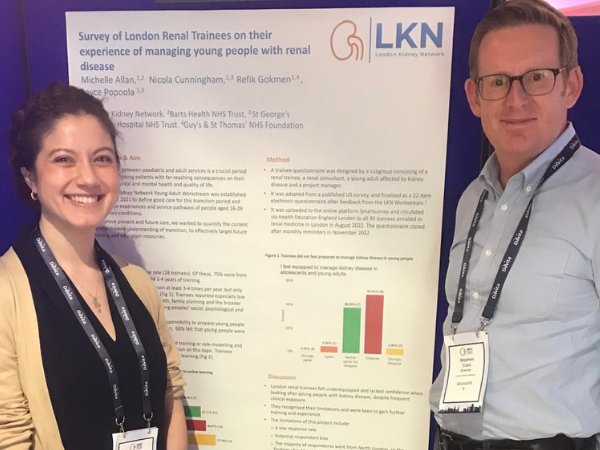
Michelle Allan and Stephen Cass
Michelle was awarded best poster in the session.
Peer Support
What is peer support?
When patients are diagnosed or starting on new treatments, speaking to someone who has been through the same journey can provide comfort, information, hope, and prepare patients for meeting the challenges with a positive approach. This is peer support.
What does the Kidney Care UK & London Kidney Network Peer Support Service offer?
An opportunity for people living in London with kidney disease, their family members, carers and/or donors to be personally matched to someone (i.e. a peer supporter) who can support them and has lived experience of kidney disease.
Who are the peer supporters?
Volunteers with lived experience who are trained in-house within Kidney Care UK, using a UK Kidney Association programme to ensure safeguarding and robust support for both volunteers and service users.

How do patients access the service?
Over 20 healthcare professionals actively promote the service across 7 London NHS trusts as peer support champions. They engage with patients, carers, donors and colleagues, and provide information on how our service offers support and how to access it. Since launching in July 2024, there have been 312 referrals for peer support from patients themselves and from kidney care staff.
What next?
The pilot service has been hugely successful and well received across London. Due to demand from patients, carers and kidney health professionals, there are plans to extend the service nationally.
Feedback on the Peer Support Service
Patient feedback
Thank you so much … [the peer supporter] was truly an excellent listener … we got on very well … I just needed to talk and [he] empathised with me. He was able to explain in more personal detail how home haemodialysis works and what the drawbacks and positive parts were to it.
What was especially important to me is having someone non-judgemental and understanding of what worries me. The chance to actually talk about things properly in “non-doctor speak” was so rewarding and was extremely helpful.
We will hopefully catch up again … which I think will be of great benefit to me on my journey and it is a great comfort to have someone as good as [the peer supporter] who listened to me.
Thank you so much once again …
Peer supporter feedback
Over the years I’ve experienced everything associated with CKD that you could imagine, and each stage is filled with more questions than answers, resulting in a fear of the unknown. I signed up as a member of the London Kidney Peer Network as I wanted to help people who are in the same position to be unafraid of what the future might hold.
LKN Finances in 2024-25
In 2024-25, the LKN continued to target our funding to assure delivery of aims and objectives focusing on:
-
- Multi-professional clinical leadership of workstreams through a distributed leadership approach
- A skilled and experienced Programme Team providing system convening and leadership, project management and business intelligence expertise
- Patient Engagement and Peer Support, in collaboration with Kidney Care UK
- Back-office support including training, events and communications
| Summary | LKN 2024/25 Budget |
LKN 2024/25 Actual |
LKN 2024/25 Variance |
|---|---|---|---|
| Income | (765,326) | (765,326) | - |
| Expenditure - Pay | 719,441 | 706,665 | (12,776) |
| Expenditure - Non-Pay | 37,000 | 23,108 | (13,892) |
| Total Expenditure | 756,441 | 729,773 | (26,668) |
| Total net underspend | (8,885) | (35,553) | (26,668) |
Looking forwards to 2025-26
Transforming kidney care through an integrated approach to population health improvement across London and Surrey
Connecting | Collaborating | Challenging
Our plans for 2024-25 set the priorities and foundations for the next three years, up to 2028, and continue into 2025-26.
We are keeping a sharp focus on the fundamentals of the kidney service in London in areas where the LKN can make a positive impact:
-
- Demand and capacity: improving the balance between demand for kidney services and our capacity to deliver the volume and quality required
- Prevention: continuing to work with ICB transformation pilots to develop services to prevent or slow progression of CKD
- Health Equity: a relentless focus on reducing health inequalities, particularly for vulnerable populations
Within our three priority areas, we will continue to drive and support improvements in our key workstreams, i.e.
-
- CKD and Cardio Renal Metabolic Prevention
- Advanced Kidney Care
- Dialysis, including Vascular Access and Dialysis at Home
- Transplantation
- Supportive Care
- Psychosocial support and rehabilitation
These priorities and workstreams are supported by our continued development of data reporting and analytics.
The voices and real-world experiences of patients, families and carers will also continue to influence our work across the entire kidney pathway including transplantation, dialysis and supportive care. We will maintain our regular conversations with people with lived experience, e.g. through our regular Patient Engagement Group meetings throughout the coming year.
The LKN Workplan for 2025-26 includes summary aims, objectives and outcomes for each area.
Workplan 2025-26
View PDF
Communication
LKN email: lkn.londonkidneynetwork@nhs.net
LKN Newsletters: Website: https://londonkidneynetwork.nhs.uk/news/